Overview
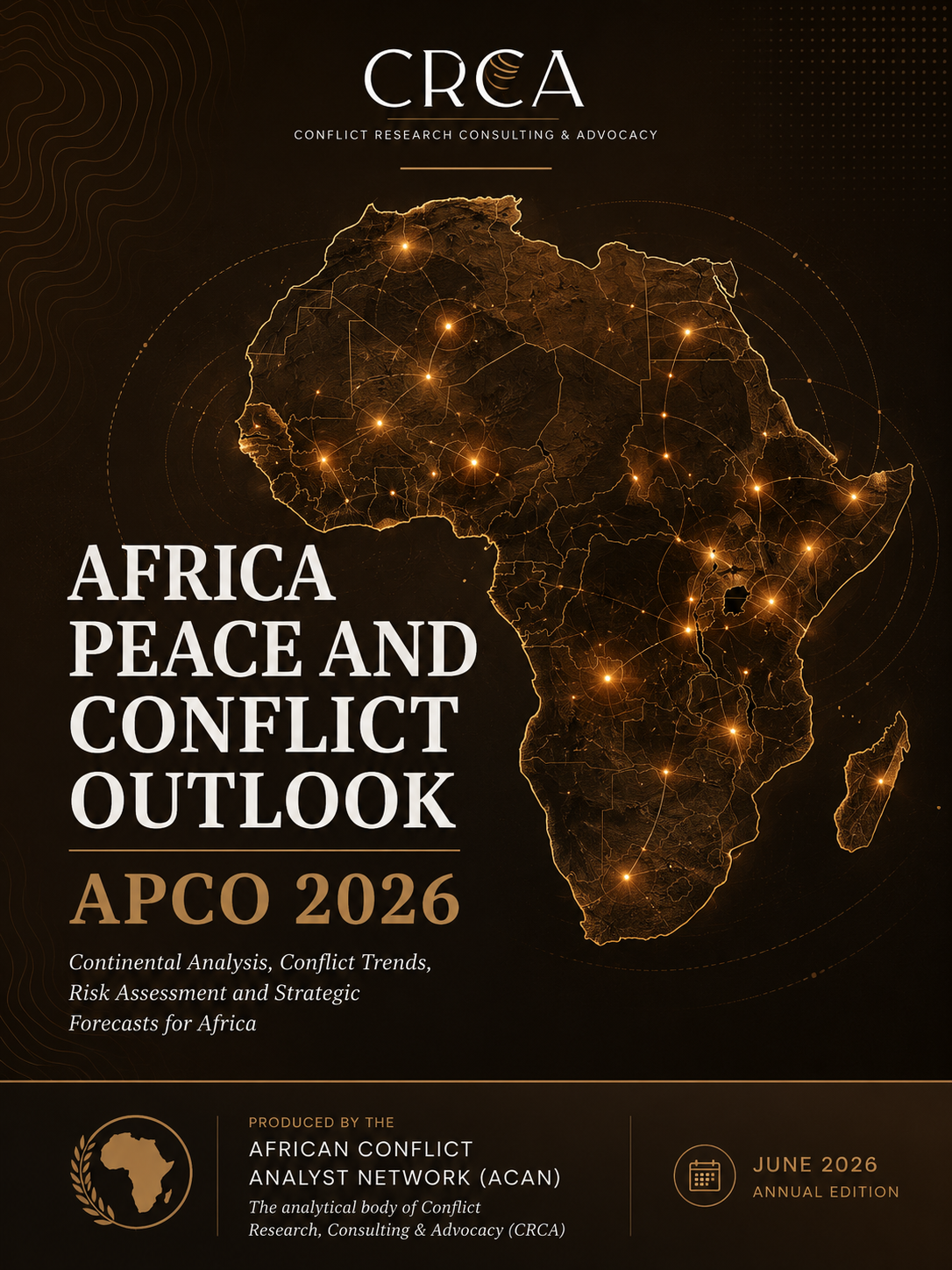
Africa's peace and security environment in 2026 is defined by the intersection of entrenched armed conflicts, accelerating governance deficits, a climate-security crisis of historic proportions, and a humanitarian emergency that stretches existing response architectures to their limits. This inaugural edition of the Africa Peace and Conflict Outlook (APCO), produced by the African Conflict Analyst Network (ACAN) --- the analytical body of Conflict Research Consulting & Advocacy (CRCA) --- presents a rigorous, evidence-based assessment of continent-wide conflict dynamics, structured risk analysis, and forward-looking strategic guidance for the period 2026--2027.
The APCO 2026 draws on the Africa Conflict Risk Index (ACRI), CRCA's proprietary multi-dimensional conflict risk methodology, which ranks all 54 African states across structural factors, governance & institutions, security & conflict dynamics, and humanitarian factors domains. The Index provides a systematic and comparable basis for conflict risk assessment, moving beyond anecdotal or event-driven analysis to capture the structural drivers that make societies vulnerable to armed violence.
Key Findings
- Six African states are classified as Very High Risk on the ACRI 2026 (CRCA--ACAN, 2026), with Sudan (75.94), Somalia (71.72), and the Democratic Republic of Congo (68.57) occupying the top three positions. A further ten states fall in the High Risk category, with another twenty in the Moderate Risk Category, meaning that more than half of Africa's 54 states carry an elevated, critical, or significant risk profile.
<!-- -->
-
Violent extremism continues its geographic expansion with particular intensity. Jihadist movements affiliated with al-Qaeda and the Islamic State have consolidated significant territorial control across the Sahel, extended their reach into coastal West Africa --- particularly Benin, Togo, and Ghana's northern regions --- and maintained an active insurgent presence in the Lake Chad Basin, northeastern Nigeria, and northern Mozambique.
-
Six unconstitutional changes of government have occurred in the Sahel since 2020, fundamentally reshaping the region's security architecture and dismantling the multilateral frameworks --- the G5 Sahel, MINUSMA, Barkhane --- that had anchored international engagement. The resulting governance vacuum has accelerated jihadist expansion and deepened humanitarian distress.
-
Electoral violence risks are elevated ahead of elections in eight countries scheduled for 2026--2027, including Nigeria, Kenya, Zimbabwe, Burundi, Uganda, Tanzania, and the Democratic Republic of Congo. Democratic backsliding --- evidenced by shrinking civic space, electoral manipulation, and executive overreach --- has been documented in over twenty countries.
-
Climate-related conflict drivers are intensifying across multiple sub-regions. Competition over water, pasture, and arable land is fuelling intercommunal violence in the Sahel, the Horn of Africa, and the Great Lakes region. Climate Vulnerability and Population Facing Acute Food Insecurity, two of the five indicators within the ACRI's Structural Factors domain, record the highest average sub-regional values in West Africa and East Africa, underlining the structural nature of this risk.
-
Displacement has reached historic highs, with over 31.5 million internally displaced persons and 14.2 million refugees recorded across the continent (UNHCR, 2026; IDMC, 2026). Sudan and the DRC together account for more than 40 percent of Africa's total internal displacement, and new displacement flows from Sudan's civil war represent one of the fastest-growing humanitarian crises globally.
-
Organised crime networks have deepened their operational integration with armed groups and fragile-state governance structures across the Sahel, the Gulf of Guinea, and the Horn of Africa. Illicit gold mining, narcotics transit, human smuggling, and artisanal weapon flows constitute a conflict-financing ecosystem that undermines both state authority and peacebuilding efforts.
+---------------------------------------------------------------------------------------------------------------------------------------------------------------------------------------------------------------------------------------------------------------------------------------------------------------------------------------------------------------------------------------------------------------------------------------------------------------------------------+
| ACRI SENTINEL - RESEARCH ALERT |
| |
| ACRI Sentinel is CRCA's AI-assisted conflict risk assessment platform. As part of its ongoing development, ACRI Sentinel has flagged a number of countries for closer analytical scrutiny based on early escalation indicators. Sentinel is still in its testing and validation phase, so these findings should be read as research output, not as operational early warning alerts. Chapter 6 covers the methodology, validation process, and preliminary results in detail. |
+---------------------------------------------------------------------------------------------------------------------------------------------------------------------------------------------------------------------------------------------------------------------------------------------------------------------------------------------------------------------------------------------------------------------------------------------------------------------------------+
Continental Risk Overview
Africa's conflict landscape in 2026 resists simplistic characterisation. The continent is simultaneously experiencing acute armed conflict, fragile peace, post-conflict reconstruction, and genuine democratic consolidation --- sometimes within the same country. This diversity of trajectories demands context-sensitive analysis rather than continental generalisations.
In the Sahel and West Africa, the collapse of counter-terrorism partnerships, the withdrawal of French forces, the expulsion of United Nations missions, and the entrenchment of military juntas have created a permissive environment for jihadist expansion. The multi-front security challenges facing Nigeria --- including Boko Haram and ISWAP in the northeast, banditry across the northwest and northcentral, and separatist agitation in the southeast --- reflect the convergence of multiple risk factors and represent one of the most complex security environments on the continent.
In East and the Horn of Africa, the fragile cessation of hostilities in Ethiopia's Tigray region, negotiated under African Union mediation in November 2022, has held in formal terms, but sub-national conflicts in Amhara, Oromia, and the Somali Region of Ethiopia continue to generate significant displacement and civilian harm. Somalia's Al-Shabaab insurgency has proven remarkably resilient despite sustained counterterrorism pressure, and the country's transitional political structures remain fragile. Sudan's civil war, which erupted in April 2023, has produced a humanitarian catastrophe of generational proportions, with famine conditions spreading across multiple states and peace negotiations making only intermittent progress.
In Central Africa, the eastern Democratic Republic of Congo remains the epicentre of overlapping armed group activity. The M23 resurgence --- backed by Rwanda according to UN Group of Experts reports --- has resulted in the capture of Goma, mass displacement, and a breakdown in relations between the DRC and its eastern neighbours. The humanitarian system is severely strained, with over 7 million internally displaced persons in the DRC alone.
Against this challenging backdrop, the APCO 2026 also documents significant peacebuilding progress in select contexts. Mozambique's Cabo Delgado province has seen a gradual improvement in security conditions following the deployment of the SADC Mission in Mozambique (SAMIM) and the Rwandan Defence Force (RDF), though the insurgency has not been comprehensively defeated. Côte d'Ivoire and Sierra Leone have maintained political stability following competitive elections. Senegal's peaceful democratic transition in 2024 demonstrated that constitutional norms can prevail even in high-pressure political environments.
Table 1: Top 10 Conflict Hotspots in Africa - ACRI 2026
Rank Country ACRI Score Primary Conflict Drivers
  1      Sudan          75.94            Civil war (SAF vs. RSF), famine, mass displacement

  2      Somalia        71.72            Al-Shabaab insurgency, fragile state institutions, drought

  3      DR Congo       68.57            M23/armed group proliferation, eastern DRC crisis, displacement

  4      Burkina Faso   65.96            Jihadist territorial control, junta governance, humanitarian blockade

  5      South Sudan    65.26            Fragile peace agreement, elite conflict, intercommunal violence

  6      Nigeria        64.29            Boko Haram/ISWAP, banditry, farmer-herder conflict, separatism

  7      Mali           59.86            Junta rule, JNIM expansion, withdrawal of international forces

  8      Ethiopia       59.56            Post-Tigray fragility, Amhara/Oromia conflict, regional tensions

  9      Cameroon       56.20            Anglophone crisis, Boko Haram, governance deficit

  10     Chad           56.07            Political transition uncertainty, cross-border insurgency, displacement
ACRI 2026 Top Ten Conflict Hotspots | Source: CRCA--ACAN, Africa Conflict Risk Index 2026 (CRCA--ACAN, 2026).
Strategic Outlook for 2026--2027
The strategic outlook for the 2026--2027 period is cautiously pessimistic in aggregate, with meaningful differentiation across sub-regions and country contexts. Three scenarios frame CRCA's forward analysis:
Deterioration Scenario (estimated probability: 40%). Current conflict trends continue or worsen. Jihadist groups consolidate territorial gains in the Sahel. Sudan's civil war deepens into a prolonged state fragmentation. The eastern DRC crisis resists diplomatic resolution. Electoral violence in multiple countries produces post-election instability. International engagement remains fragmented and under-resourced. Climate shocks generate cascading food security crises that overwhelm humanitarian response capacity.
Stabilisation Scenario (estimated probability: 45%). Targeted international and regional investments in conflict prevention, humanitarian response, and governance support yield measurable improvements in specific contexts. The AU Peace and Security Council increases its operational engagement. ECOWAS maintains diplomatic pressure on Sahelian juntas. New mediation efforts in Sudan produce a sustainable ceasefire. The DRC crisis is contained through regional diplomacy. Electoral assistance programmes reduce post-election violence risks.
Transformation Scenario (estimated probability: 15%). Structural reforms address the root causes driving Africa's most entrenched conflicts. Sustained investment in inclusive governance, economic opportunity, climate adaptation, and community-based peacebuilding shifts the structural risk environment. New African-led conflict prevention frameworks demonstrate effectiveness at scale. This scenario requires sustained political will and a multi-year investment horizon that currently appears beyond the reach of the prevailing international consensus.
The distribution of probabilities across these scenarios underscores the pivotal importance of decisions made in 2026. The window for prevention remains open in several emerging risk contexts, and CRCA urges policymakers, development partners, and African institutions to invest in the evidence-based, early warning capacity and political frameworks that can shift outcomes toward stabilisation and, ultimately, transformation.
Priority Policy Recommendations
-
Strengthen the African Union's Peace and Security Architecture, including full operationalisation of the African Standby Force and the Continental Early Warning System (CEWS), and increase the AU Peace Fund's capitalisation to reduce dependence on external conflict-response financing.
-
Prioritise prevention over response by shifting at least 15 percent of peace and security funding toward early warning, conflict prevention, and mediation, in line with the 2018 AU--UN Joint Framework for Enhanced Partnership in Peace and Security.
-
Address the climate-security nexus through integrated national adaptation plans that explicitly incorporate conflict risk analysis, and by establishing climate-security focal points within the AU Commission and IGAD structures.
-
Condition bilateral and multilateral development assistance on measurable commitments to constitutional governance, electoral integrity, and civic freedoms, while ensuring that conditionality is applied consistently and without geopolitical double standards.
-
Scale up community-based peacebuilding and local mediation as cost-effective, contextually grounded, and durable interventions that complement formal diplomatic processes.
-
Enhance regional coordination on violent extremism, with particular attention to preventing the southward spread of Sahelian jihadist networks into coastal West Africa and the Great Lakes region.
-
Invest in a comprehensive humanitarian response to Sudan's civil war, treating it with the same political and financial urgency accorded to comparable crises elsewhere in the world.
-
Deploy ACRI Sentinel-style AI-powered early warning tools and conflict risk assessment analysis platforms to complement existing monitoring systems, enabling anticipatory action in the critical window before armed violence erupts.